Writing a term paper or thesis with ChatGPT: where it helps and where it invents sources
ChatGPT is genuinely good at structuring a chapter and tightening your prose, but asked for references it will produce a publication that does not exist. What it does well, why it fails specifically on sources, and how to give it real publications with printed page numbers.
It is two in the morning, the paragraph on teacher burnout is written, and all that is missing is the reference. You ask ChatGPT for the literature. You get two entries: authors, title, journal, year, issue, page range. They look exactly like everything you have seen in other people's bibliographies.
In the morning you paste the first title into Google Scholar. Nothing. You try it in quotation marks. Still nothing. The journal exists, the author exists and genuinely writes about education — she simply never wrote that paper.
This piece is about what actually works when you write with ChatGPT, where and why it breaks, and what you can do about it without giving up the tool.
What ChatGPT genuinely does well
Start with the honest side of the ledger, because the list is long and real.
Organising what you already know. Drop in three weeks of scattered reading notes and ask for a chapter structure. What comes back usually needs editing, but it removes the worst stage of all — the empty page.
Rephrasing your own sentences. A clumsy paragraph comes back readable. That is not writing for you; it is what a good colleague reading your draft does.
Summarising papers you found yourself. Paste the PDF, ask for the main claims. The model summarises the text you supplied, so there is nowhere for invention to enter. That is a completely different operation from “give me sources”.
Language work. Consistent register across the whole thesis, punctuation, breaking up sentences that ran away from you, translating foreign-language quotes for a footnote.
Arguing with you. “What are the counterarguments to this claim?”, “what is missing in this reasoning?” — here the model is often better than most conversations you will have before your defence.
In every one of these the tool works on material you hand it. The trouble starts precisely when you ask for material it does not have.
Where it breaks: the references
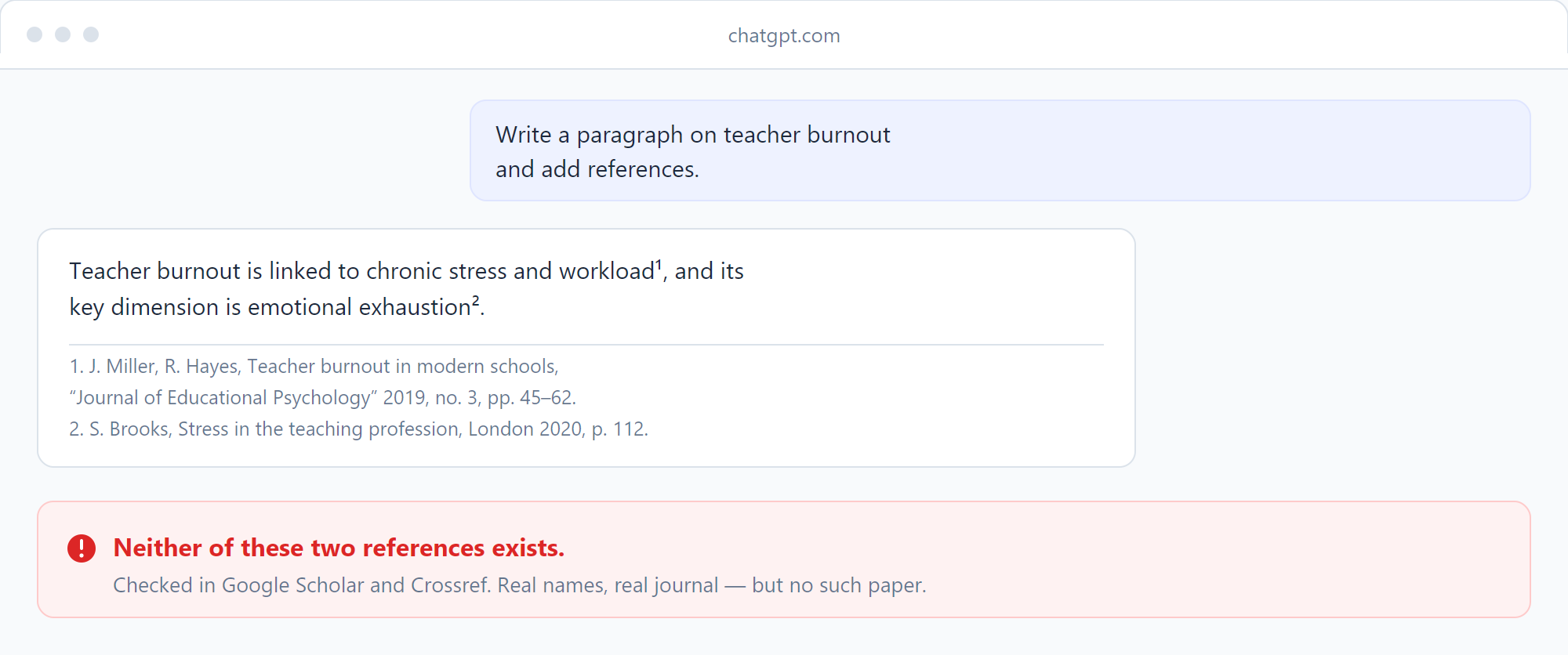 Flawless formatting, a real journal, credible names. Nobody ever wrote that paper.
The phenomenon has a name and a literature of its own. Back in 2023 a case report described ChatGPT as a generator capable of producing “artificial hallucinations” in scientific writing — expert-sounding content that cannot be verified¹.
The dangerous part is that such a reference does not look suspicious. Reviews of the field note that generated text can be almost indistinguishable from human writing², and a bibliography is the one part of a thesis where everything looks alike: surname, italicised title, year, pages. A fabricated entry differs from a real one only in that no document stands behind it.
The variants worth watching for:
- a wholly non-existent paper — real authors, real journal, invented title;
- a real paper with invented details — the publication exists, but the year, issue or pages are wrong;
- a real paper with an invented quote — the quoted sentence never appears in the text, though it sounds plausible;
- a page number from the reader — the most common and most treacherous, because the source is fine and only the page is wrong.
We cover recognising these in do AI tools invent sources and how to detect AI-fabricated sources.
Why sources specifically
This is not a fault you can patch with a better prompt. A language model predicts the next stretch of text from what it saw during training. When you ask for a paragraph, prediction works beautifully — sentences about teacher burnout really do read the way they read.
When you ask for a reference, the same thing happens. The model predicts what a reference in this field looks like: which surnames are plausible, which journal fits, what page range is typical. The result is statistically excellent and bibliographically empty, because nowhere along the way is there a lookup in a library catalogue.
Hence the practical conclusion: do not ask the model for sources — give the model sources. The rest of this piece is about how.
The stakes rise: term paper, bachelor's, master's
The consequences of a fabricated reference differ sharply across the three levels, and it is worth saying so plainly.
A term paper. Your lecturer rarely checks the bibliography entry by entry. The risk is low — but this is exactly where the habit forms, and the habit travels to work where someone will check.
A bachelor's thesis. Your supervisor knows the literature of their field and spot-checks references, usually the ones that surprised them. A single entry that cannot be found changes the character of every conversation about your thesis: from that moment everything gets verified.
A master's thesis and above. A reviewer checks systematically, and integrity committees increasingly start with the bibliography. At this level a fabricated reference is not a slip — it is an allegation of misconduct, with the procedures that follow. We write separately about whether professors can detect AI-generated sources.
The fix: connect real sources to the conversation
Instead of asking the model for references from memory, you can give it access to a corpus of real publications. Before inserting a footnote the assistant then asks about a specific claim, and the answer contains a publication, a quote and a page number — or an honest statement that nothing supports it.
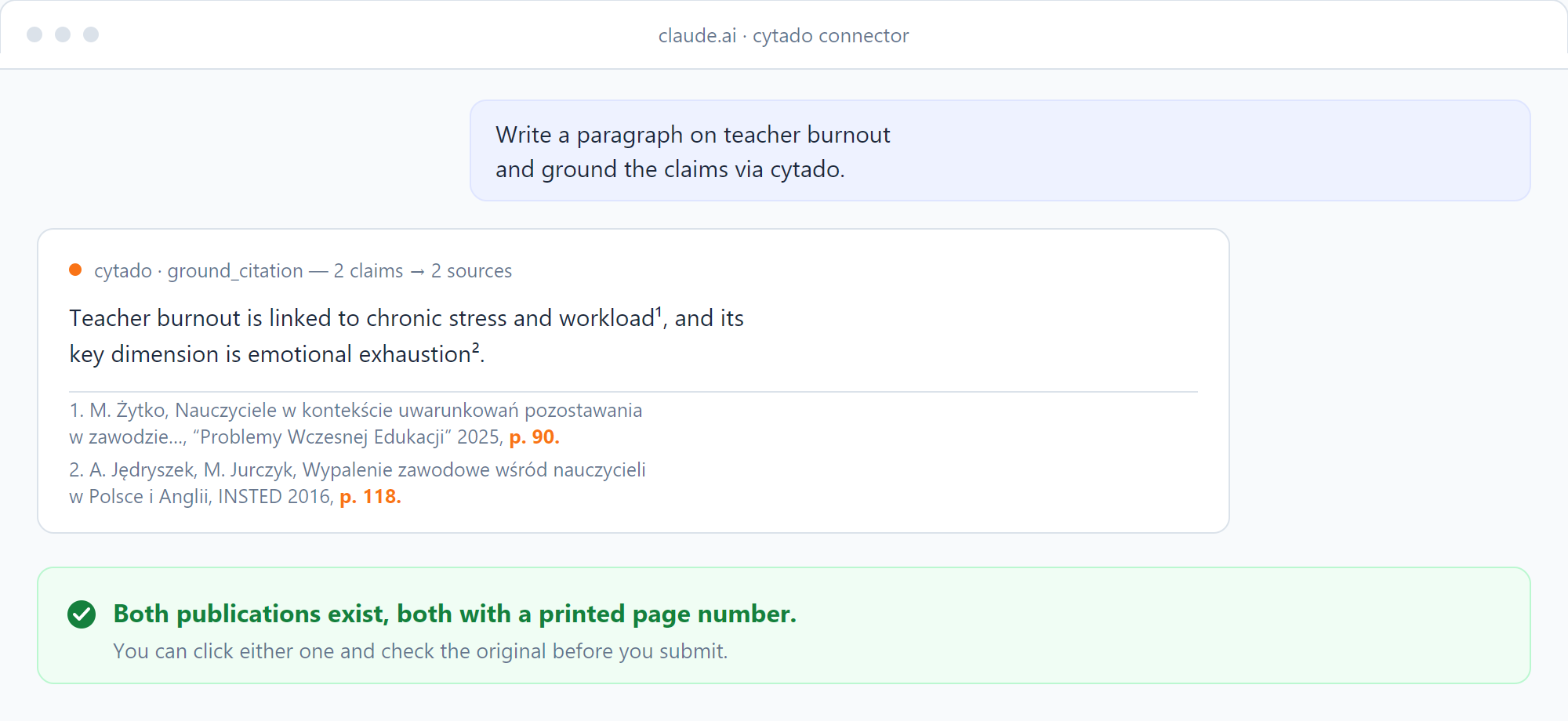 These two publications exist, and the page numbers come from the printed pagination, not from a PDF reader's toolbar.
The difference from an ordinary conversation is single but fundamental: the reference comes from a document, not from a prediction. We read publications page by page with the edition's numbering preserved, so “p. 90” in the footnote leads to where the quote actually sits. It is the same page your supervisor lands on when they reach for the original — why that is not the same as a PDF page number we covered separately.
It works in several places, depending on where you write:
- the MCP connector for Claude — paste one address into settings, no code and no API key;
- cytado for ChatGPT — several routes, including the connector on paid plans;
- the Google Docs add-on — highlight a sentence in your document and insert a real footnote in one click;
- the bibliography checker — if you already have a list and only want it verified.
When the answer is “not found”
This is the part that most separates such a tool from a model answering out of memory.
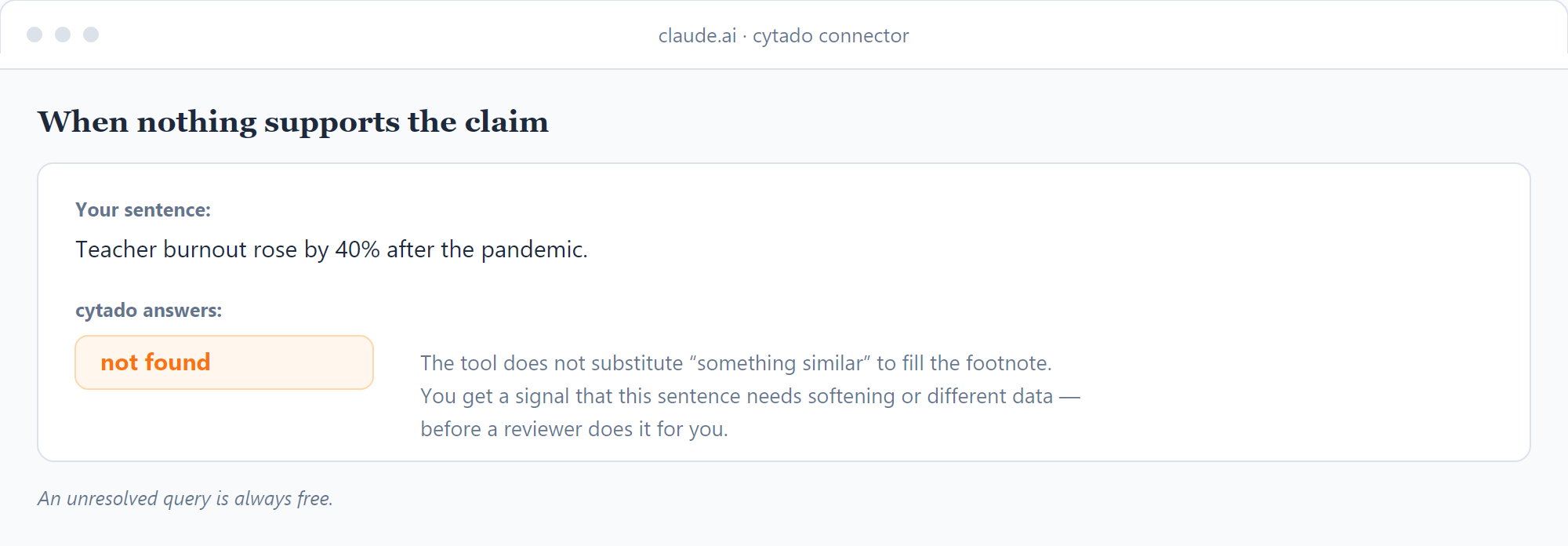 A missing source is information, not a failure — and it is free.
“Teacher burnout rose by 40% after the pandemic” sounds specific, which is exactly what makes it dangerous. If nothing supports it, you have three options: soften it to what can be documented, look for the figure in sector reports rather than journal literature, or cut it. All three beat a reference that someone will check.
A model without connected sources will never say “I don't know”. It will say something that sounds like an answer.
Getting started in five minutes
- Create a free account. A hundred resolved citations a month, no card. Usually enough for one chapter.
- Connect it where you write. In Claude that means pasting one address into connector settings; in Google Docs, installing the add-on from the store.
- Write normally. Ask for a paragraph and for the claims to be grounded via cytado. The footnotes appear alongside the text instead of being bolted on the night before submission.
What this does not solve
Honestly, because that is part of the answer to “can I write my thesis with ChatGPT”.
The tool will not write the thesis for you, and it is not meant to. It also will not excuse you from reading what you cite: the reference points at a specific page precisely so that you can go and look. It will not replace a conversation with your supervisor about scope, nor decide for you whether a given claim belongs in your work at all.
It does not replace your university's policy, either. If your department requires a declaration about AI tools, file one — using an assistant to edit your prose is a very different thing from submitting someone else's work, but you are the one who has to be able to show that difference.
And the most important part: verification stays with you. The tool shortens the path from a sentence to a document from an hour to a few seconds, but clicking the link before you submit is still your job. If you want to check a bibliography you already have, start here.
References
- H. Alkaissi, S. I. McFarlane, Artificial Hallucinations in ChatGPT: Implications in Scientific Writing, “Cureus” 2023, p. 1. DOI: 10.7759/cureus.35179
- I. Dergaa, K. Chamari, P. Żmijewski, H. Ben Saad, From human writing to artificial intelligence generated text: examining the prospects and potential threats of ChatGPT in academic writing, “Biology of Sport” 2023, p. 616. DOI: 10.5114/biolsport.2023.125623
Frequently asked
- Am I allowed to use ChatGPT when writing my thesis?
- It depends on your university's policy, and these differ sharply: some departments require a declaration of how AI was used, some permit it for language editing only, some say nothing at all. One rule holds everywhere: the tool may help organise and phrase your own thinking, but the claims and the references are yours. A citation you did not check is your citation, not ChatGPT's.
- How do I know whether a source the AI gave me actually exists?
- The quickest test takes a minute: paste the exact title in quotation marks into Google Scholar and into Crossref search. A real paper turns up by title. If the search returns only similar-sounding work but never that specific paper, you are looking at a fabricated entry. You can also run a whole bibliography through our source checker at once.
- Will my supervisor know I used AI?
- AI text detectors are unreliable in both directions and fewer universities lean on them. It is far easier to get caught another way: a supervisor reaches for a reference that cannot be found, or checks a quote on the page you gave and it is not there. That is not a detector question — it is one click into your bibliography.
- How is a printed page number different from a PDF page number?
- The PDF of an article printed on journal pages 610–625 is often a document whose reader shows pages 1–16. Copy the number from the reader and your footnote says “p. 3” instead of “p. 612”. A reviewer checking page 3 will not find your quote there, and the reference looks fabricated even though the paper is real.
- What does it cost to connect real sources to ChatGPT or Claude?
- The account is free and the free pool is 100 resolved citations a month, no card. For a single thesis chapter that is usually enough. You pay only for citations you actually received — a “not found” answer is always free.